Memphis and Shelby County
Are solar panels worth it in Memphis, TN?
Are solar panels worth it in Memphis? The two figures that answer it are both published and no page selling solar in this city puts them next to each other: the payback MLGW expects for Shelby County, and how long a panel is usually warranted for.
The payback against the warranty
Payback MLGW expects for a Shelby County system, or longer
25 years
MLGW, checked 2026-08-17
Warranty ENERGY STAR says a solar panel usually carries
−20 years
ENERGY STAR, checked 2026-08-17
Years the published payback runs past that warranty, at least
5 years
MLGW's sentence reads 25 years or longer, so the gap above is a floor rather than an estimate (MLGW, checked 2026-08-17). A warranty is not a lifespan either, and plenty of panels outlast one.
The two numbers nobody puts next to each other
MLGW publishes its own expectation for a solar system in this city, and it is not the sentence a
proposal opens with. On the grounds of the utility's low electric rates and this area's
below average annual solar irradiance
, it says, payback likely will take 25 years or
longer, even with federal tax incentives
(MLGW, checked 2026-08-17).
Read the last four words again. That estimate was written for a buyer who could still claim the
federal residential credit, and that buyer no longer exists. The credit is not available for any
property placed in service after December 31, 2025
(IRS,
page updated 04-Jul-2026, checked 2026-08-17), and MLGW says the same thing locally in its own
words. So 25 years is the optimistic figure, not the pessimistic one.
Against it sits a number from a federal programme with nothing to sell. Describing rooftop solar for
homeowners, ENERGY STAR says solar panels usually carry a 20-year warranty
(ENERGY STAR,
checked 2026-08-17).
A payback running at least five years past the warranty on the main component is the sum at the top of this page. Plenty of Memphis systems beat it, and the rest of this page is about which ones and why. But that sum is where the case has to start, and almost nothing written about solar in this city starts there.
What "below average irradiance" actually means
Irradiance is how much sunlight lands on a square metre over a year. It sets the ceiling on what any array in a given place can produce, and no amount of equipment quality moves it. Two identical systems, one here and one four hundred miles west, make different amounts of electricity for the same money.
MLGW's own description of this area is below average annual solar irradiance (sunshine)
, and
the utility offers it as one of the two reasons for the payback it publishes (MLGW, checked
2026-08-17). No irradiance figure appears on this page, because none has been read off a primary
source. The utility's own words are what there is.
That matters more than it sounds, because production estimates in a sales document are modelled rather than measured, and a model has to be told where the roof is. An estimate generated against a sunnier location, or against a national figure, produces a payback line that was never going to happen on a roof in Shelby County. It is also the kind of error that takes a decade to become visible.
The roof under the array is the second clock
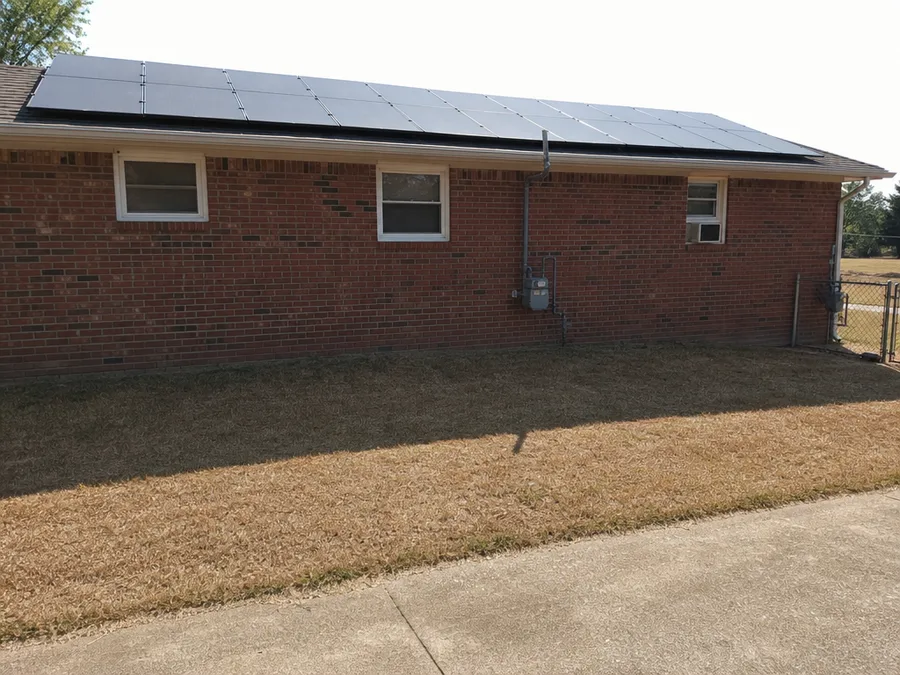
Memphis housing stock leans heavily to one shape: single storey brick with a low pitch asphalt shingle roof above it. That is a straightforward surface to mount an array on. It is also the shortest-lived part of the assembly, and it is the part the array is bolted to.
ENERGY STAR puts the sequence plainly: If your roof needs renovations, it makes sense to replace
it before installing solar panels to avoid having to remove and reinstall the panels at a later
date
(ENERGY STAR, checked 2026-08-17).
Set that against a payback measured in decades and it stops being a scheduling note. A roof that is halfway through its life when the array goes on will need replacing well before the array has paid for itself, and replacing it means taking the array down and putting it back up. Nobody's payback line carries the cost of doing that.
So the roof survey matters as much as the production estimate, and it is worth settling first. If a system on an ageing roof has already stopped producing, the order of operations is worth settling before anyone quotes anything: solar panel repair in Memphis, TN covers what a dead array costs while it waits.
Do solar panels increase home value?
The figure most people have seen comes from Berkeley Lab. Its study of home sales found buyers
paying about $4 per watt
more for houses with host-owned photovoltaic systems, or a
premium of about $15,000 for a typical PV system
(Berkeley Lab,
checked 2026-08-17).
It is a real study and it is worth knowing what it measures. The dataset is almost 22,000 sales
of homes, almost 4,000 of which contained PV systems in eight states from 1999 to 2013
(Berkeley
Lab, checked 2026-08-17). Every one of those sales closed before the federal residential credit
ended, and a good many of them closed before the current generation of hardware existed.
Age is not the only reason the number travels badly. A resale premium is a statement about what a future buyer believes an array is worth to run, and that belief tracks the tariff it runs under. Where surplus output gets bought, an array on the roof keeps paying whoever lives there. Where it does not, the same array is worth whatever the next occupant's daytime consumption can absorb, which is a much more personal number.
No Memphis-specific resale figure is published on this site, because none has been read off a primary source. If a proposal in front of you carries one, the useful questions are which market it was measured in and in which years.
Where the arithmetic in Memphis actually moves
There is one lever and MLGW names it. Because it holds an all-requirements contract with TVA, MLGW
is prohibited from buying electricity from any other source
, so it does not offer 'net
metering'
, and generation beyond what a property is using at that instant flows to the MLGW
grid without financial benefit
(MLGW, checked
2026-08-17). Self-generating customers also carry a standing monthly line, the Electric Service
Availability charge, currently $14.40 for residential customers and subject to change (MLGW, checked
2026-08-17).
Follow that through and only the kilowatt hours the building consumes as it makes them are worth anything. Everything that raises that share shortens the payback, and nothing else does. MLGW puts the industry figures at about 60% of instantaneous output for the average home against about 80% for the average business (MLGW, checked 2026-08-17), which is why the strongest case in this city is a building that is open and drawing power through the middle of the day. Commercial solar in Memphis, TN is where that case is set out.
On a house, the equivalent lever is storage. It holds the surplus until the evening instead of
donating it, and MLGW's own page tells customers it is vital to size the generation capacity
carefully and/or to include battery storage
(MLGW, checked 2026-08-17). That sentence is worth
more than it looks, because it is the electric utility rather than an installer saying it. What
storage changes, and what it does not, is on
solar battery installation in Memphis, TN.
What to ask before anyone quotes a payback
Four questions separate a payback line that means something from one generated for a different country.
- Which tariff does it assume? If the model credits exported output at anything, it was not built for this utility. What MLGW requires and what it pays is on MLGW net metering and solar interconnection in Memphis.
- What share of the output does it assume the building uses? That one assumption moves the answer further than any equipment choice on the quote.
- Which incentive is it counting? What survived, and how the answer changes fifteen miles into Mississippi or Arkansas, is on Tennessee solar incentives and what is left in Memphis.
- How old is the roof? A payback measured in decades, on a roof with ten years left in it, is two jobs being priced as one.
Getting all four answered in writing is unusual in this market. A salesperson who will not put them in writing has told you something anyway.
When the answer is no
Some roofs in this city do not carry a case, and a site that only ever tells people to buy is not much use in working out which ones. Take a house that is empty through the middle of the day, on a roof near the end of its life, with no storage in the budget. That is the combination where MLGW's own payback sentence is simply the accurate one (MLGW, checked 2026-08-17), and where the useful advice is to fix the roof and leave the array alone.
Turn those inputs around and you have the systems that do work here: a building drawing power while the sun is up, a roof with its life ahead of it, and somewhere for the surplus to go. That is a narrower set of buildings than the industry sells to. It is also a real set, which is the part the sceptics reading this market tend to miss.
Every figure on this page, and the rest of the sum it belongs to, sits on solar installation in Memphis, TN.
What people ask about the numbers
What is the payback period on solar panels?
Nationally it gets quoted as a range, and every version of that range assumes a utility that buys surplus output. Memphis does not have one. MLGW publishes the local answer directly: on the grounds of its low electric rates and this area's below average annual solar irradiance
, payback likely will take 25 years or longer, even with federal tax incentives
(MLGW, checked 2026-08-17). The thing that moves that number is not the hardware on the quote. It is how much of the output the building consumes while it is being made.
Do solar panels increase home value?
The figure people get quoted comes from Berkeley Lab, whose study of home sales found buyers paying about $4 per watt
more for houses with host-owned photovoltaic systems, or a premium of about $15,000 for a typical PV system
(Berkeley Lab, checked 2026-08-17). The sales it measures ran from 1999 to 2013 across eight states. A resale premium is a statement about what a future buyer thinks an array is worth to run, and that depends on the tariff it runs under. No Memphis figure appears on this site because none has been read off a primary source.
Is solar worth it if nobody is home during the day?
In this city that is the whole question rather than a detail. With no net metering, anything the house does not use at the instant it is made flows to the MLGW grid without financial benefit
(MLGW, checked 2026-08-17). A house that is empty from eight until six gives away its best hours unless something holds them until the evening. That is what storage does, and it is why solar battery installation in Memphis, TN reads differently here than it does in a net-metered state.
How much do solar panels cost in Memphis?
A Memphis installed price is not published here, for the same reason the rest of this page carries dates: nobody has read one off a source worth naming, and a national average would be worse than no number at all. What can be said is what a price has to be read against. The share of output the building will actually use decides what the system earns, and the age of the roof decides whether it gets to keep earning it. Two quotes at the same price can behave completely differently on both, which is why the cheaper one is often the worse buy.
See what the arithmetic does on your own roof
Send the address, the rough age of the roof and a recent MLGW bill. What comes back is a view on your building, including the view that it is not worth doing.