Memphis and Shelby County
Solar battery installation in Memphis, TN
Solar battery installation in Memphis, TN answers a question most of the country does not have to ask. Where net metering exists, a battery is a convenience: the grid already banks your surplus and hands it back. MLGW does not offer net metering, so a Memphis array's surplus leaves the property and earns nothing. Storage is the part that decides whether the kilowatt hours you generate are worth anything at all.
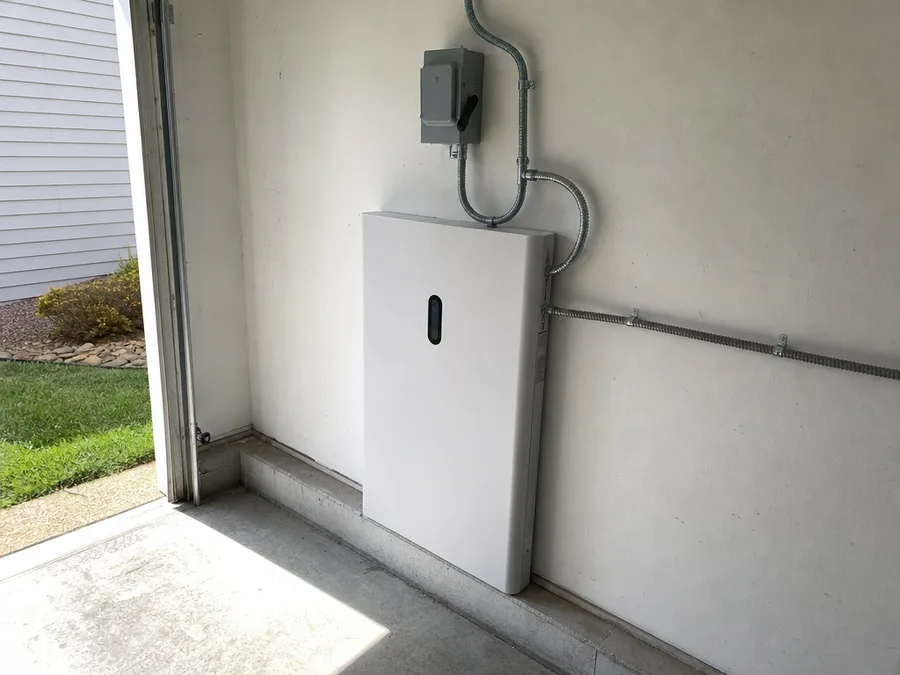
Why storage is a different question here
In a net-metered state the grid is the battery. Send a kilowatt hour out at noon, take one back at eight, and the meter settles up. A physical battery in that world buys convenience and outage cover, and the financial case for it is usually thin because the utility is already doing the storing for free.
Memphis has none of that. MLGW's position is published in the utility's own words: it does not
offer 'net metering'
, because it holds an all-requirements contract with TVA and is
prohibited from buying electricity from any other source
. What that means at the meter is
that generation beyond instantaneous consumption is excess
and flows to the MLGW grid
without financial benefit
(MLGW, checked 2026-08-17).
Read that as a design instruction rather than as bad news, because that is how the utility writes
it. The same page continues: it is vital to size the generation capacity carefully and/or to
include battery storage
(MLGW, checked 2026-08-17). The electric utility for Shelby County, with
no reason at all to sell anyone a battery, names storage as half the answer to sizing solar here.
Whether the array in front of the battery pays at all is the wider question, and it has its own answer on are solar panels worth it in Memphis, TN, which works through what is left of the case once the federal credit is out of it.
Two purchases that share a cabinet
Almost every disappointing battery in this market is one bought for one reason and judged on the other.
Self-consumption is the money argument. The array makes more than the house needs at midday, that surplus currently leaves for nothing, and a battery holds it until the evening when the house is buying at retail. Every kilowatt hour stored and used later is a kilowatt hour not purchased. No transfer equipment is strictly required for this, and the battery works alongside the grid rather than in place of it.
Backup is the resilience argument, and it is a different installation. Keeping a house alive with the grid down means the battery has to be able to run islanded, which requires equipment that separates the circuits you intend to keep from everything else, plus a decision about which those are. A whole-house backup and a two-circuit backup are different sizes, different budgets and different conversations.
The two overlap in hardware and diverge in cost. Being clear about which one you are buying is the single most useful thing you can do before anyone quotes.
Sizing against what you are currently giving away
The number worth starting from is not the array's rating. It is the share of the array's output that is currently leaving the property.
MLGW publishes the industry figure behind its own guidance: the average home uses about 60% of
instantaneous solar output
, against about 80% for the average business (MLGW, checked
2026-08-17). Where exports are credited, the remaining share is banked and returned. Here it is not.
On a clear day in an empty house that share can be much larger than the average, and on a July
afternoon with the air conditioning running flat out it can be close to zero.
So the sizing question becomes: on the days you export most, how many kilowatt hours leave, and over how many hours? A battery that covers the average day and gets overwhelmed on the good days is undersized. A battery that could hold three times the biggest surplus you ever produce is money spent on capacity that will never fill.
Twelve months of MLGW usage data is what turns that from an argument into a calculation. Without it, sizing is somebody's habit applied to your roof.
The load that decides it, in this city
A Memphis electricity bill is a cooling bill for a large part of the year, and the shape of that load is what makes storage behave differently here than in a heating-dominated market.
Cooling demand peaks in the afternoon and stays high into the evening, which means the house is still drawing hard after the array's output has fallen away. That evening tail is the window a battery is actually covering. It also means a good deal of midday output is being consumed rather than exported on the hottest days, so the surplus available to store is largest in the shoulder seasons and on mild days, not in the middle of the heatwave people picture when they think about solar.
The practical consequence is that a battery sized off a single August bill will be the wrong size. The whole year is the input.
What storage does not do
Being straight about the limits is the point of this page.
There is still no export market. Stored energy you never use is energy MLGW does not buy, and nothing about a battery converts surplus into income under the standard residential arrangement.
The standing charge stays. Self-generating customers carry a monthly Electric Service Availability charge, currently $14.40 for residential customers and subject to change (MLGW, checked 2026-08-17). That line does not move when a battery is added, and it does not pause when a system is switched off. What it costs an array that has stopped producing is covered on solar panel repair in Memphis.
The payback arithmetic also survives. MLGW's own published expectation for Shelby County is that
payback likely will take 25 years or longer
, and it names two reasons: low electric rates, and
below average annual solar irradiance
for this area (MLGW, checked 2026-08-17). Storage
improves the share of output that has value, which is a real gain and a different thing from a short
payback.
And the federal residential credit is not coming back through a battery. It ended for property placed in service after 31 December 2025 (IRS, checked 2026-08-17).
Where a battery sits in the utility's process
Storage is part of the generating arrangement, not an appliance added to it, so it belongs in the interconnection paperwork rather than beside it.
MLGW runs distributed generation through a documented sequence: research, application, construction,
then testing. The forms are listed on the utility's own
Green Power Switch
document page, which names the Application for Interconnection, the Interconnection and Parallel
Operations Agreement that follows approval and serves as the notice to proceed, and the System
Acceptance Form issued once acceptance testing is complete. MLGW also publishes a warning worth
repeating: Be wary of installers who begin construction before MLGW has approved your
application, which MLGW does not recommend
(MLGW, checked 2026-08-17).
That warning applies to storage exactly as it applies to modules. What the utility requires, in order, is set out at length on MLGW net metering and solar interconnection in Memphis.
Retrofit, and the question that decides it
Adding a battery to an existing array turns on the inverter already on the wall.
A hybrid or storage-ready inverter can usually take a battery on the DC side, which is the tidier and generally cheaper route. A string inverter with no storage capability needs an AC-coupled battery carrying its own inverter, sitting alongside the original. Neither is wrong. They cost differently and they behave differently in an outage, and which one applies is a five-minute question once the inverter model is known.
If the existing inverter is near the end of its life anyway, replacing it with a hybrid unit and adding storage at the same time is one mobilisation instead of two.
Siting, safety and who inspects it
A battery is a permanent electrical installation and is inspected as one. Shelby County's Building Code Board names the Joint Technical Codes and the National Electrical Code as what is adopted locally, which is the authority that decides clearances, siting and disconnect requirements for a particular installation. It does not name a code edition on that page, and neither do we: the answer to any specific clearance question comes from the office enforcing the adopted edition, not from a national summary.
Practically, siting in Memphis usually means a garage wall or a shaded exterior wall rather than an unshaded south face. Batteries derate and age faster when they are hot, and a west-facing brick wall in this climate spends the afternoon well above air temperature.
What drives the number on a quote
We publish no price of our own, because we have not verified one and this site does not state figures it has not checked. What moves a quote is not mysterious:
- usable capacity in kilowatt hours, which is the largest single input
- whether backup is included, and how many circuits are backed up
- whether the existing inverter can take storage or a second inverter is needed
- the run between the battery and the panel, and whether the panel has room
- permitting and the utility's process
Two quotes that differ by thousands usually differ on the second and third of those rather than on the battery itself. Ask what is being backed up before comparing them.
What to send with a request
The more of this you can put in one message, the more useful the reply:
- the array size and roughly when it was installed, if there is one already
- the inverter brand and model
- twelve months of MLGW usage, or the account address and what summer bills run
- whether you want backup, bill reduction, or both
- what you would need to keep running in an outage, if backup matters
That is enough to say whether storage is worth pricing, and enough to say when it is not. If the answer is that a battery will not pay on your usage, we would rather write that than sell around it.
Questions people actually ask
Will MLGW pay me for what the battery does not use?
No. MLGW's own page states that it does not offer 'net metering'
and explains why: it holds an all-requirements contract with TVA and is prohibited from buying electricity from any other source
. Power generated beyond what the property is using at that moment is treated as excess and flows to the MLGW grid without financial benefit
(MLGW, checked 2026-08-17). There is a separate route, a five-year TVA Dispersed Power Production contract paid at avoided cost, and it is covered on MLGW net metering and solar interconnection in Memphis.
Will a battery keep my house running in an outage?
Only if it is installed to do that. Backup requires the battery and a transfer arrangement that separates the circuits you want kept alive from the rest of the panel, and the size of that backed-up group is a decision made at design rather than afterwards. A battery bought purely to shift daytime output into the evening can be installed without any of it, which is cheaper and does nothing at all when the lights go out.
How big a battery do I need?
The useful question is not how big the array is, it is how much of the array's output currently leaves the property. MLGW publishes the industry figure it works from: the average home uses about 60% of instantaneous solar output
(MLGW, checked 2026-08-17). Where exports are paid for, the other share is banked. Here it is given away, so the storage worth buying is roughly the part you are currently donating, on the days you donate the most.
Can I add a battery to an array that is already installed?
Usually, and the deciding factor is the inverter. Some systems accept storage on the DC side and some need an AC-coupled battery with its own inverter alongside the existing one. Either way the generating arrangement on record with the utility changes, so it goes through the interconnection process rather than being treated as an appliance swap.
Does a battery pay for itself in Memphis?
MLGW's published position on solar in Shelby County is that due to MLGW's low electric rates and this area's below average annual solar irradiance (sunshine), payback likely will take 25 years or longer, even with federal tax incentives
(MLGW, checked 2026-08-17). A battery does not repeal that sentence, and anyone telling you it does is selling rather than counting. What storage changes is the share of output that has any value, and whether the house keeps working when the grid does not. Those are worth buying on their own terms. A short payback is not on the table and we will not pretend otherwise.
Is there still a tax credit for a home battery?
Not the federal residential one. The IRS states that the credit is not available for any property placed in service after December 31, 2025
(IRS, checked 2026-08-17), and MLGW says the same locally: Residential solar incentives end for projects completed after 12/31/2025
(MLGW, checked 2026-08-17). What remains, and what is different in Mississippi and Arkansas, is set out on Tennessee solar incentives and what is left in Memphis.
Ask what a battery would actually change on your bill
Send twelve months of MLGW usage if you have it, or the account address and roughly what the summer bills run. Sizing storage without a load profile is guesswork.