Memphis and Shelby County
Solar panel repair in Memphis, TN
Solar panel repair in Memphis, TN is mostly not panel repair. The modules usually outlive everything attached to them, so a system that has gone quiet is normally an inverter, a breaker, a rooftop connector or a monitoring account that stopped reporting. What makes a dead system expensive here is the part nobody mentions: MLGW keeps billing the monthly charge that comes with self-generating, whether or not the array is producing anything.
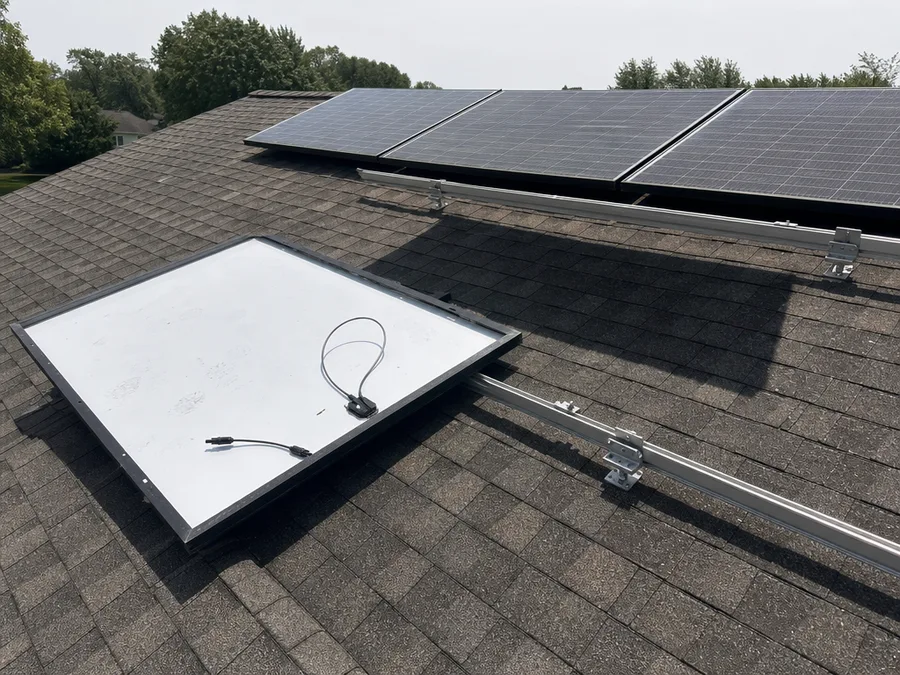
What usually breaks, and what almost never does
The modules are the part people photograph and the part that rarely fails. Glass, cells and frame sit still for decades. Everything that switches, converts or connects has a shorter life, and that is where a repair call almost always lands.
A string inverter carries the highest failure rate on any residential system, and it is the one component whose failure takes the whole array down at once. Below it sit the parts that fail quietly: a rooftop connector that has worked loose in twenty summers of expansion and contraction, a module-level optimiser or rapid-shutdown device that has stopped reporting, a DC isolator that has let water in, an AC breaker that has tripped and been left. Any of those can cost one string rather than the system, which is the failure mode worth understanding, because the array keeps producing and nothing looks wrong from the driveway.
The last category is not a fault at all. Monitoring accounts lapse, home routers change, and a gateway that lost the network two years ago reports nothing forever. Plenty of systems that people believe are dead are producing normally into a dashboard nobody can reach.
The Memphis part of the diagnosis
Two local conditions change what a low reading means.
The first is heat. Every module loses output as its cell temperature rises, and a low pitch asphalt shingle roof in a Memphis July is one of the hotter places a module gets installed. Output on a hazy 95 degree afternoon can sit well under output on a clear April morning with the same sun angle, and that is the array behaving as designed. Comparing this August against last August tells you something. Comparing August against April tells you almost nothing.
The second is what the roof is made of. Memphis housing stock leans heavily to single storey brick with low pitch asphalt shingle above it, which is a straightforward surface to work on and an unforgiving one to keep watertight once it has aged. Penetrations that were sound when the array went on are the first thing to check when a fault shows up alongside a stain on a ceiling.
The thing that makes downtime cost more here than elsewhere
In most of the country a solar owner whose system is down loses the export credit and the offset, and that is the whole bill. Memphis is not most of the country.
MLGW does not offer net metering. In the utility's own words, because it holds an all-requirements
contract with TVA it is prohibited from buying electricity from any other source
, so power
generated beyond what the house is using at that instant flows to the grid without financial
benefit
(MLGW, checked 2026-08-17). Self-generating customers also carry a standing monthly
line: the Electric Service Availability charge, currently $14.40 for residential customers and
subject to change (MLGW, checked 2026-08-17).
That charge does not pause when an inverter faults. A system that went quiet in March and gets looked at in October has spent seven months buying back its own production at retail while still paying the charge that comes with being a generator. Neither figure is large. The combination is what turns a small fault into a bill nobody decided to pay.
What a straight answer looks like
A repair request is worth a real answer before anyone drives out. Most systems can be narrowed down from four things:
- the inverter brand and roughly what age the system is
- what the inverter display or the app shows, including any fault code
- when the output changed, and whether it stopped dead or fell off gradually
- whether anything else changed at the same time: a breaker panel replacement, a roof repair, a storm, a new router
A fault code plus a date usually separates "a part is being ordered" from "somebody needs to be on the roof". A gradual fall over two seasons is a different investigation from a hard stop on a Tuesday.
What this page does not cover
Panel washing is not repair, and it is not something requested through this site. Soiling matters as a diagnostic signal, because a shaded or dirty string reads differently from a failed one, but the fix for it is not a repair call.
Nor is a system expansion. Adding modules, upsizing an inverter or adding battery storage changes the generating capacity on record with the utility, and that runs through the interconnection process rather than through a service visit. What MLGW requires before a system is switched on, and what it requires when one changes, is set out on MLGW net metering and solar interconnection in Memphis.
Before you spend money on a system that never worked
Some repair requests are not repairs. They are systems that never produced what the buyer was told they would, and the gap is usually arithmetic rather than a fault.
MLGW publishes the figure that explains most of them: industry research shows the average home
uses about 60% of instantaneous solar output
. In a market with no net metering, the other 40%
flows to the grid for nothing unless it is stored or shifted (MLGW, checked 2026-08-17). An array
sized against annual consumption, in a place that pays for nothing you export, will underperform the
promise while working perfectly.
That is not a repair. It is a sizing problem, and the honest answer to it is on Tennessee solar incentives and what is left in Memphis and in the storage page above, not on an invoice.
The payback the original promise was built on is worth reading against the one the utility publishes before spending anything on the system: are solar panels worth it in Memphis, TN sets MLGW's own figure beside the warranty a panel usually carries.
If you want to check any of this against the people who publish it rather than against us: MLGW's own guidance is on its Green Power page, and the credential the utility points homeowners to is NABCEP. We make no claim to it.
Questions people actually ask
Why is my solar system not producing anything?
In roughly this order: the inverter has faulted or failed, an AC breaker or the rooftop DC disconnect has opened, a connector or a rapid-shutdown device on the roof has failed, or one string is down while the rest carries on. The last one is the reason a system can lose a third of its output and still look like it is working. If the monitoring account is the only thing that stopped, nothing is wrong with the hardware at all.
How long do solar panels last?
Manufacturers warrant modules for decades and warrant inverters for a fraction of that, which tells you where the failures are. A Memphis array also runs hot for months at a time, and every module loses output as it heats up, so a summer afternoon reading that looks low against a spring one can be normal rather than a fault.
Does a repair need a new MLGW application?
Replacing a failed part with an equivalent one is not the same as changing what the system does. Changing the inverter rating, adding modules or adding storage changes the generating capacity MLGW has on record, and MLGW runs its distributed generation work through a documented sequence of research, application, construction and testing, with the forms listed on its own Green Power Switch document page. Ask before the work is scheduled, not after.
Should I repair the array or take it down before a new roof?
ENERGY STAR puts it plainly: If your roof needs renovations, it makes sense to replace it before installing solar panels to avoid having to remove and reinstall the panels at a later date
(ENERGY STAR). The same logic runs backwards. If the shingles under a fifteen-year-old array are near the end, paying to fix a string this month and paying again to lift the whole array next spring is two mobilisations for one problem.
What is a dead system actually costing me in Memphis?
Two things at once. You are buying back every kilowatt hour the array was covering, at retail, and MLGW is still billing the monthly Electric Service Availability charge that comes with being a self-generating customer, currently $14.40 for residential customers and subject to change (MLGW, checked 2026-08-17). Neither number is dramatic on its own. Together they are the reason a system that has been quiet since spring is worth a phone call rather than a note in a drawer.
Tell us what the system is doing
Send the inverter brand, roughly when it went quiet and what the display or the app shows. That is usually enough to say whether it is a part or a visit.