Memphis and Shelby County
Commercial solar installation in Memphis, TN
Commercial solar installation in Memphis, TN works on a different arithmetic from the house next door, and the reason is published by the utility. MLGW puts the average business at about 80% instantaneous use of its own solar output against about 60% for the average home, and in a market where exported power is not bought, the share you consume yourself is the whole return. A daytime load under a large flat roof is the best case this city offers.
The one number that makes this a better market for business than for homes
Memphis is a hard place to sell residential solar honestly, and the reason is published by the
electric utility rather than argued by us. MLGW does not offer net metering. It holds an
all-requirements contract with TVA and is prohibited from buying electricity from any other
source
, so generation above what the property is using at that instant flows to the MLGW grid
without financial benefit
(MLGW, checked 2026-08-17).
That single rule reorders the whole market. If exported power is worth nothing, the only output with value is the output consumed on site at the moment it is made, and the return on a system is governed by how well a building's load lines up with a solar day.
MLGW publishes exactly that comparison: the average home uses about 60% of instantaneous solar
output, while the average business uses about 80%
(MLGW, checked 2026-08-17). A house is largely
empty at midday. A distribution building, a workshop, a clinic or an office is not.
Twenty points of instantaneous use is not a marketing distinction in a market with no export credit. It is most of the difference between a project that stacks up and one that does not.
Memphis roof stock, and why it suits this
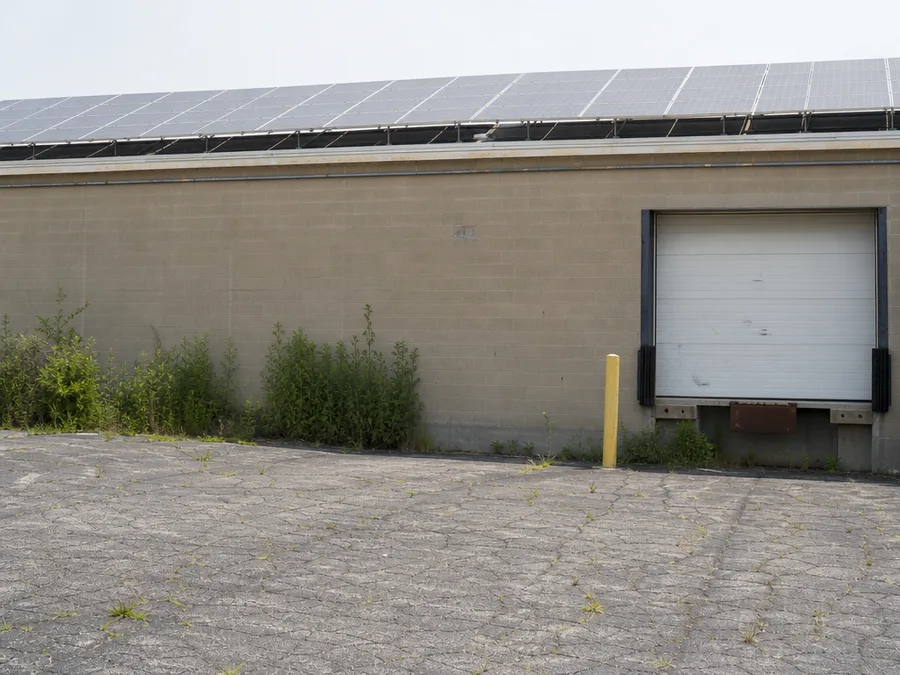
Memphis is a logistics city. Large single storey buildings with flat membrane roofs and daytime electrical load are a bigger share of the built stock here than in most metros this size, and that combination is close to the ideal case for solar under MLGW's rules: an unshaded, unbroken, low-parapet surface directly above a load that runs while the sun is up.
Three practical questions decide most rooftop projects here:
Roof age and warranty. Membrane warranties usually name who is allowed to penetrate or load the surface, and installing under one without involving the manufacturer is how a twenty year warranty becomes void. A ballasted system that never penetrates the membrane avoids some of that and adds weight instead, which moves the question to the next line.
Structural capacity. Ballast is dead load. Whether an existing roof structure can carry it is a structural engineer's answer, not an installer's, and on older buildings it is the item most likely to change the design.
What is already on the roof. Mechanical curbs, drains, skylights and existing runs decide the usable area far more than the building's footprint does. The gap between total roof area and array area on a working building is routinely a third or more.
Rate schedule first, roof second
Before any of the above matters, read the bill.
A business on a demand-based schedule and a business on a general service schedule get different things from the same array, because on the first, a large share of what is being paid for is the peak, not the volume, and solar reduces the two by different amounts. The rate schedule is printed on the MLGW bill.
The self-generation charge follows the same logic. MLGW states that for non-residential customers the
Electric Service Availability charge varies by applicable electric rate, currently beginning at
$32.00 for GSA part 1 customers, and is subject to change
(MLGW, checked 2026-08-17). It is a
standing monthly line that arrives with being a generator, and it scales with the schedule rather
than with the system.
Any model that does not start from your actual rate schedule is a template with your address typed into it.
Financing that still exists locally
The residential incentive picture in Tennessee is thin and getting thinner, and that is covered in full on Tennessee solar incentives and what is left in Memphis. The commercial side has one genuinely local instrument.
C-PACER is commercial property assessed clean energy and resiliency financing, administered here by
EDGE. Memphis adopted it in September 2022, the first city in Tennessee to do so. EDGE lists
qualifying objectives that include to decrease energy consumption
and produce clean,
renewable energy
, and it publishes two thresholds that decide eligibility before anything else:
projects must exceed $1 million, and at least 25% of spending must go to minority and women owned
business enterprises (EDGE,
checked 2026-08-17).
Read those thresholds as a filter rather than as a hurdle. A single roof on a mid-sized building is usually well under the first of them, and C-PACER becomes relevant when solar is one line in a larger capital project: a re-roof, an envelope upgrade, storage, or several buildings at once.
On the federal side we publish no figure. MLGW's own words are that new rules are being developed
for commercial installations
(MLGW, checked 2026-08-17), the underlying provisions have been in
litigation, and a percentage that is right this month may be wrong the month you sign. That is a
question for your tax adviser, dated to the week you commit.
What MLGW requires, and in what order
Commercial interconnection runs through the same documented sequence as residential, with one difference that matters at scale.
MLGW's process is research, application, construction, then testing. Its own document index lists the Service Policy Manual, the Distributed Generation System Requirements, the Application for Interconnection, the Interconnection and Parallel Operations Agreement issued after MLGW and TVA approval and serving as the notice to proceed, and the System Acceptance Form issued once acceptance testing is complete (MLGW, checked 2026-08-17).
The difference at scale is the form itself: there is one Application for Interconnection for systems at or below 1 MW DC and a separate one for mid to large scale systems above that connecting to distribution. Most single-building rooftops sit under the threshold and a multi-building programme may not.
MLGW also publishes a caution that is worth carrying into procurement: Be wary of installers who
begin construction before MLGW has approved your application, which MLGW does not recommend
(MLGW, checked 2026-08-17). A contract that schedules mobilisation before the utility has responded
is a contract that has priced your risk as its convenience. The full sequence, with what each
document does, is on
MLGW net metering and solar interconnection in Memphis.
Storage on a commercial roof
Where a residential battery is mostly about shifting an evening tail, a commercial battery is usually about the peak.
The same export rule applies, so storage on a business roof still does the job of keeping output on site rather than giving it away. What changes is that on a demand-based schedule the value of discharging into a short afternoon peak can outweigh the value of the kilowatt hours themselves. Whether that is true for a given building depends on the shape of its load, which is a question the interval data answers and an estimate does not.
The residential version of the same argument, and what storage does and does not change under MLGW's rules, is on solar battery installation in Memphis.
The honest bottom line for a Memphis business
MLGW's published expectation for solar in Shelby County is that payback likely will take 25 years
or longer, even with federal tax incentives
, and it names two causes: low electric rates, and
below average annual solar irradiance
for this area (MLGW, checked 2026-08-17).
That statement is written about homes, and the 80% instantaneous-use figure is the reason a commercial project starts from a better position than the one it describes. It is not a reason to ignore it. The residential version of the same sum, including what the roof under an array costs a long payback, is on are solar panels worth it in Memphis, TN. Low electric rates cut both ways: they are why Memphis is a good place to run a building and why the savings per kilowatt hour displaced are smaller here than in a high-rate market.
A commercial project in this city stands up on a daytime load, a suitable roof, the right rate schedule and a realistic view of what the utility will and will not pay for. It does not stand up on an export credit that does not exist, and any proposal that shows one has not read MLGW's rules.
What to send
- the building address, and the roof type and its age
- a recent MLGW bill, showing the rate schedule
- interval or demand data if the account has it
- what else is planned for the building, and when
- whether a re-roof is already on the capital plan
Those five decide whether this is worth pricing, and roughly what it would be priced against. If the answer is that the roof needs replacing first, that is the answer you will get.
Questions people actually ask
Why does commercial solar work better than residential in Memphis?
Because the load lines up with the sun. MLGW publishes the figure it works from: the average home uses about 60% of instantaneous solar output, while the average business uses about 80%
(MLGW, checked 2026-08-17). In a market with no net metering, the output you do not use at the moment you make it is given away, so a business that is open and drawing power all day keeps a materially larger share of what its roof produces.
Does MLGW charge a business for self-generating?
Yes, and the amount depends on the rate schedule. MLGW states that for non-residential customers the Electric Service Availability charge varies by applicable electric rate, currently beginning at $32.00 for GSA part 1 customers, and is subject to change
(MLGW, checked 2026-08-17). Which schedule a building sits on is on its bill, and it is the first thing to read before anyone models a return.
What is C-PACER and can a Memphis business use it?
C-PACER is commercial property assessed clean energy and resiliency financing, administered locally by EDGE. Memphis adopted it in September 2022, the first city in Tennessee to do so. Qualifying objectives in EDGE's own words include to decrease energy consumption
and produce clean, renewable energy
. It carries thresholds: projects must exceed $1 million and allocate at least 25% of spending to minority and women owned business enterprises (EDGE, checked 2026-08-17). It is not a small-project instrument.
Is there still a federal credit for commercial solar?
The residential credit ended. MLGW's own summary of the position is that residential solar incentives end for projects completed after 12/31/2025
and that new rules are being developed for commercial installations
(MLGW, checked 2026-08-17). We publish no percentage for the commercial side, because no figure for it was read from a primary source on the day this page shipped and the provisions have been in litigation. Ask your own tax adviser rather than a solar website, and ask them the week you sign.
Does a large system need a different application?
Yes. MLGW's document index lists two Applications for Interconnection, one for systems at or below 1 MW DC and a separate one for mid to large scale systems above that connecting to distribution (MLGW, checked 2026-08-17). Most single-building rooftops sit under the threshold. A portfolio or a ground array may not.
Our roof has ten years left. Should we wait?
ENERGY STAR's guidance is that if your roof needs renovations, it makes sense to replace it before installing solar panels to avoid having to remove and reinstall the panels at a later date
(ENERGY STAR). On a membrane roof that guidance is sharper than on shingle, because the warranty usually names who may penetrate or load the surface. A roof with ten good years and a system designed for twenty five is a removal and reinstall nobody budgeted for.
Get the roof looked at before the roof decides for you
Send the building address, the roof type and age, and a recent MLGW bill showing the rate schedule. Those three decide whether this is worth pricing.